
Table of Contents
Why is fitness important ?
Fitness is not only about a strong body it is about having a good and healthier lifestyle, improving your energy, developing good habits, whether you are a beginner or intermediate fitness can give you a long time benefit in your life.
Benefits of fitness?
- Physical activity helps your body to stay strong and active.
- If you are physically active it can also support your mental health.
- Improves flexibility.
- It can also reduce your stress
Weekly fitness routine
MONDAY-CHEST+TRICEPS
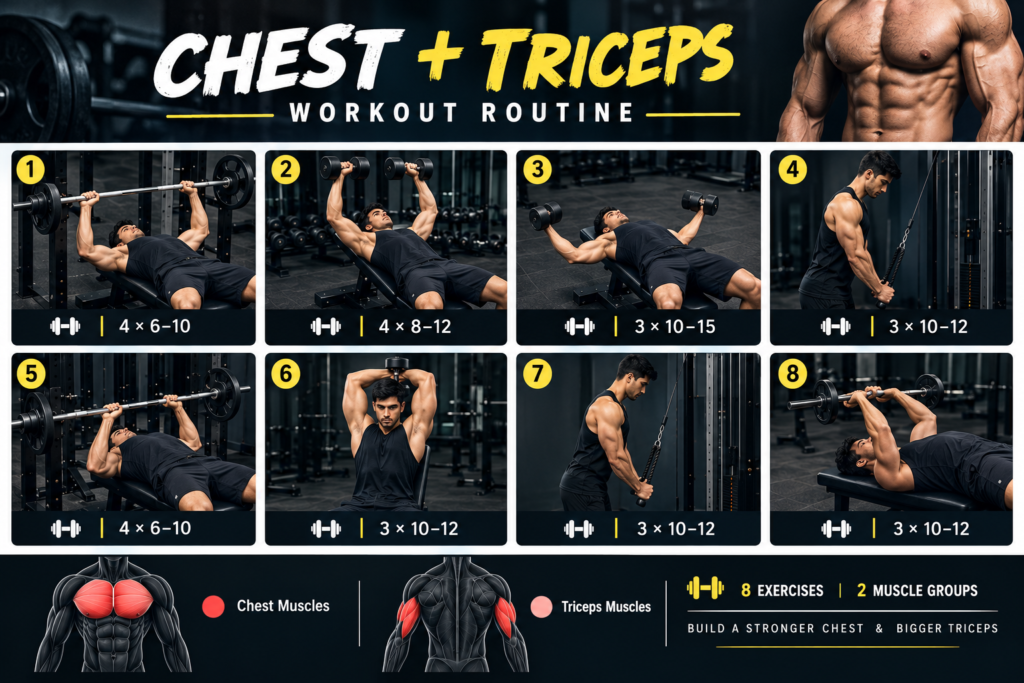
CHEST
- Barbell Bench Press (Flat, Incline, Decline) – Core builder for overall chest mass.
- Dumbbell Bench Press (Flat, Incline, Decline) – Allows a greater range of motion and joint comfort.
- Dumbbell Pullover – Targets the chest and serratus anterior.
- Push-ups (Standard, Incline, Decline, Weighted) – Bodyweight staple for upper body control.
- Chest Dips (Leaning forward) – Hits the lower chest and lower sternal fibers.
TRICEPS
- Close-Grip Barbell Bench Press – Primary compound builder for triceps thickness.
- Weighted or Bodyweight Triceps Dips (Upright torso) – Emphasizes the long and lateral heads.
- Skullcrushers (EZ-Bar / Dumbbell Lying Triceps Extensions) – Excellent stretch on the long head.
- Bench Dips – Accessible bodyweight exercise using a bench or chair.
TUESDAY-BACK+BICEPS
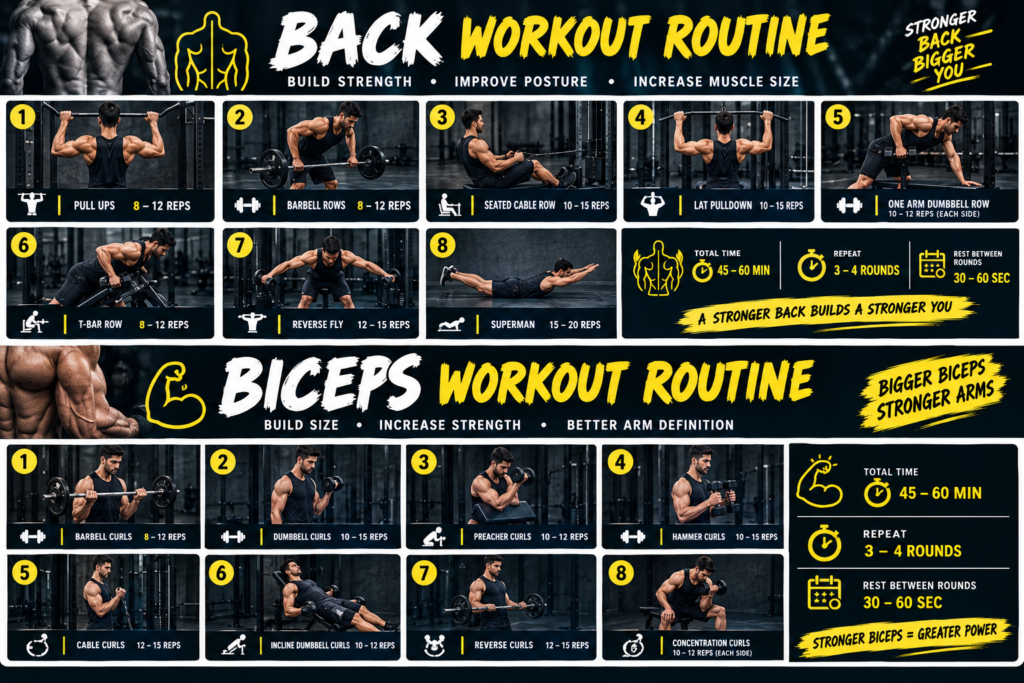
BACK
- Lat Pulldown — 3 sets × 8–12 reps
Focus on pulling your elbows down and keeping the movement controlled. - Seated Cable Row — 3 × 10–12
Keep your chest up and avoid using momentum. - One-Arm Dumbbell Row — 3 × 8–12 each side
Pull the dumbbell toward your hip rather than straight toward your chest. - Chest-Supported Row — 2–3 × 10–12
A good option for training your upper and mid-back while keeping the movement stable. - Straight-Arm Pulldown — 2 × 12–15
Concentrate on squeezing your lats throughout the movement.
Biceps
- Dumbbell Biceps Curl — 3 × 8–12
Keep your elbows relatively still and lower the weights slowly. - Hammer Curl — 3 × 10–12
Keep a neutral grip and control both the lifting and lowering phases. - Cable Curl — 2 × 12–15
Use a controlled range of motion and avoid swinging.
WEDNESDAY-SHOULDER
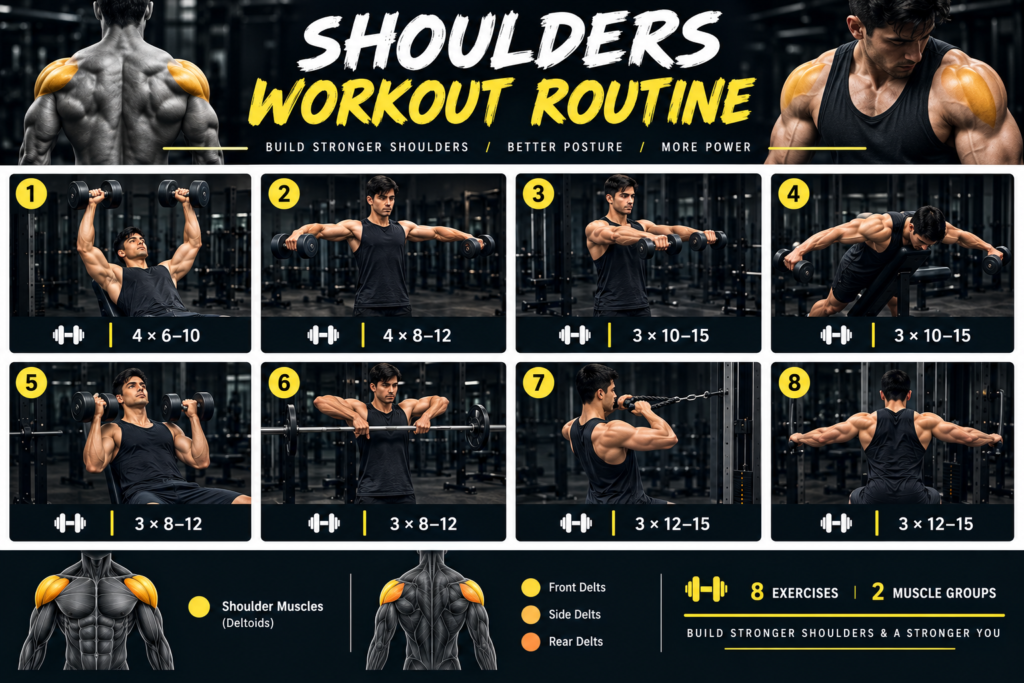
1. Dumbbell Shoulder Press — 3 Sets × 8–12 Reps
Start with a comfortable weight and press the dumbbells upward in a controlled movement. Avoid using momentum and keep your core stable.
2. Dumbbell Lateral Raises — 3 Sets × 10–15 Reps
Lateral raises target the side shoulders and can help develop balanced shoulder strength. Use a manageable weight and perform each repetition slowly.
3. Rear-Delt Fly — 3 Sets × 10–15 Reps
This exercise focuses on the rear shoulders. Keep your movements controlled and avoid swinging the weights.
4. Front Raises — 2 Sets × 10–12 Reps
Front raises work the front portion of the shoulders. Use a light-to-moderate weight and maintain good control.
5. Face Pulls — 2–3 Sets × 12–15 Reps
Face pulls train the rear shoulders and upper-back muscles while encouraging good shoulder movement and stability.
COOL-DOWN
After your workout, spend around 5 minutes doing gentle shoulder and upper-body stretches. Keep the stretches comfortable and avoid forcing any movement.
THURSDAY-CARDIO
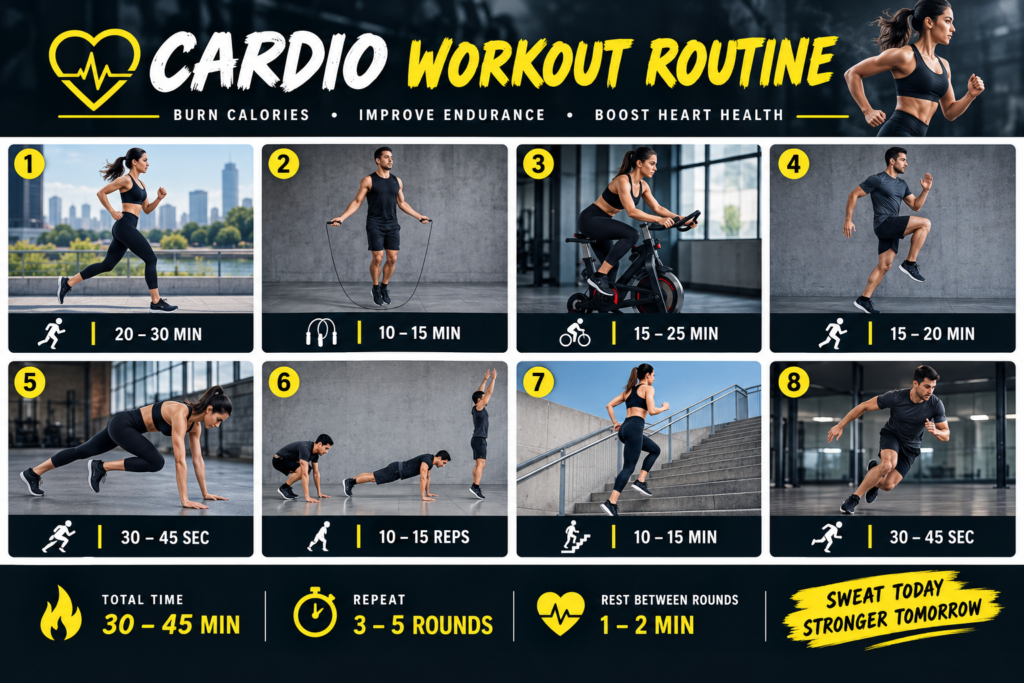
WARM-UP
Begin with an easy warm-up to prepare your body for exercise.
- Easy walking — 3 minutes
- Arm circles — 30 seconds
- Leg swings — 10 each leg
- Light jogging or cycling — 2–3 minutes
1. Treadmill Walking or Light Jogging — 10 Minutes
Start at a comfortable pace. If you are new to cardio, brisk walking is a great option. Gradually increase the pace as your fitness improves.
2. Cycling — 10 Minutes
Use a stationary bike or outdoor bicycle. Maintain a steady pace that raises your heart rate without making you feel exhausted.
3. Stair Climber — 5–10 Minutes
Use a comfortable pace and maintain good posture. Hold the rails only when necessary for balance.
4. Jumping Jacks — 2 Sets × 30 Seconds
Perform these at a comfortable pace. Take a short rest between sets and focus on controlled movements.
5. Easy Jog or Brisk Walk — 5 Minutes
Finish the main workout with a comfortable walk or light jog to gradually bring your intensity down.
COOL DOWN-5 MINUTES
End your cardio session with an easy walk followed by gentle stretching for your legs, hips, and shoulders. Breathe slowly and allow your body to recover.
FRIDAY-ABS AND FOREARMS
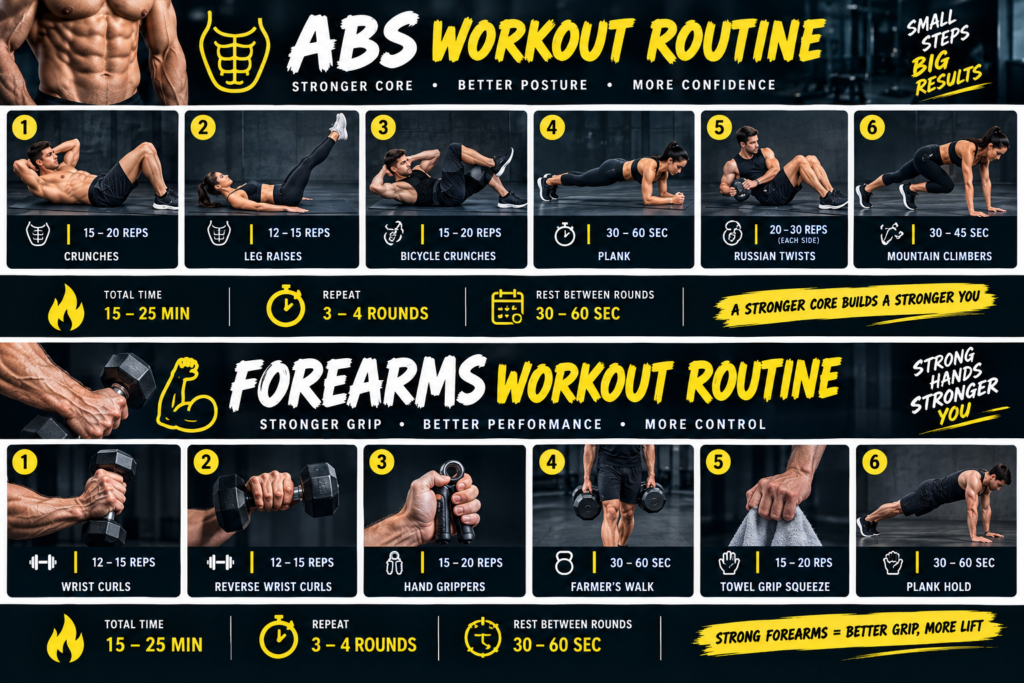
Start with a light warm-up to prepare your body.
- Marching or light jogging — 3 minutes
- Arm circles — 30 seconds
- Wrist circles — 15 each direction
- Bodyweight squats — 2 × 10
- Light torso rotations — 10 each side
1. Dead Bug — 3 Sets × 8–12 Reps Each Side
Lie on your back and slowly extend the opposite arm and leg while keeping your movements controlled. This exercise trains core stability.
2. Plank — 3 Sets × 20–40 Seconds
Keep your body in a straight line and brace your core. Start with a shorter duration and gradually build up your time.
3. Reverse Crunch — 3 Sets × 10–15 Reps
Use a controlled movement and avoid swinging your legs. Focus on engaging your abdominal muscles throughout the exercise.
4. Bird Dog — 2 Sets × 8–12 Reps Each Side
From a hands-and-knees position, extend the opposite arm and leg. This helps develop core control and balance.
5. Farmer’s Carry — 3 Sets × 20–30 Seconds
Hold a comfortable pair of dumbbells and walk with an upright posture. This exercise challenges your grip and forearms while also involving your core.
6. Wrist Curls — 2 Sets × 12–15 Reps
Use a light weight and move your wrists through a comfortable range of motion. Keep the movement slow and controlled.
7. Reverse Wrist Curls — 2 Sets × 12–15 Reps
Work the opposite side of the forearm using a light weight. Avoid using momentum.
COOL-DOWN 5 MINUTES
Finish with gentle stretches for your wrists, forearms, back, and core. Keep the stretches comfortable and avoid forcing any movement.
SATURDAY-LEG DAY
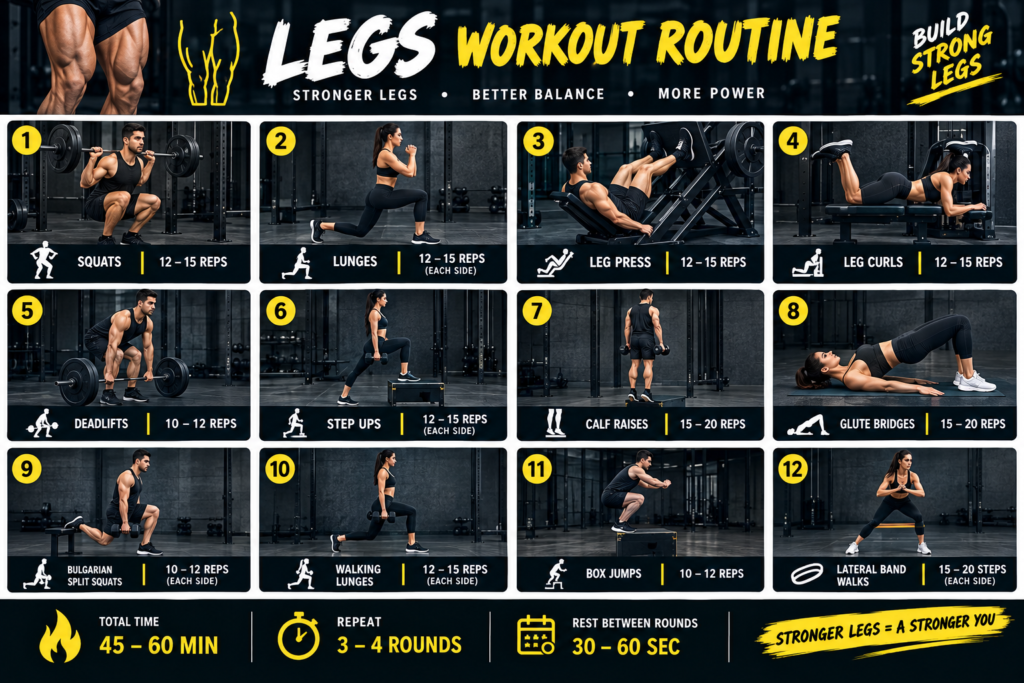
WARM UP -5 MINUTES
Start with a light warm-up to prepare your legs and joints.
- Brisk walking — 3–5 minutes
- Bodyweight squats — 2 × 10
- Leg swings — 10 each leg
- Walking lunges — 1 × 10 each leg
- Ankle circles — 10 each direction
LEG DAY
1. Goblet Squats — 3 Sets × 8–12 Reps
Hold a dumbbell close to your chest and squat down with control. Keep your chest up and maintain a comfortable range of motion.
2. Leg Press — 3 Sets × 10–12 Reps
Use a manageable weight and control the movement throughout each repetition. Avoid locking your knees at the top.
3. Romanian Deadlift — 3 Sets × 8–12 Reps
Keep your back in a neutral position while moving your hips backward. Use a comfortable weight and focus on controlled movement.
4. Walking Lunges — 2 Sets × 8–10 Reps Each Leg
Take controlled steps forward and lower your body comfortably. Keep your balance and maintain good posture.
5. Leg Curl — 2–3 Sets × 10–15 Reps
Perform each repetition slowly and focus on controlling the weight rather than using momentum.
6. Standing Calf Raises — 3 Sets × 12–15 Reps
Rise onto your toes and slowly lower your heels. Use a full, comfortable range of motion.
High Protein Diet Chart for Beginners
Starting the gym is not only about exercise. Nutrition plays an important role in supporting energy, recovery, and muscle development. A balanced, protein-rich diet can help beginners fuel their workouts while providing carbohydrates, healthy fats, vitamins, and minerals.

Early Morning
- 1 glass of milk or fortified soy milk
- 1 banana or another fruit
- A small handful of nuts
This provides a combination of protein, carbohydrates, and healthy fats to begin the day.
Breakfast
Option 1: Vegetable paneer sandwich + milk
Option 2: Oats cooked with milk + nuts and seeds
Option 3: Paneer or tofu stuffed roti + yogurt
Option 4: Besan chilla with paneer filling + yogurt
Breakfast should be filling and provide enough energy for the rest of the morning.
Mid-Morning Snack
- Greek yogurt or thick curd with fruit
- Roasted chickpeas
- A small serving nuts and seeds
Lunch
- 2–3 rotis or a serving of rice
- Dal or rajma/chole
- Paneer or tofu
- Mixed vegetables
- Salad
- Curd or yogurt
Combining different plant-based protein sources throughout the day can make it easier to get a variety of nutrients.
Pre-Workout Snack
- Banana + milk
- Fruit + yogurt
- Peanut butter on whole-grain toast
- Small bowl of oats with milk
Keep the meal comfortable rather than eating a very large meal immediately before exercising.
Post-Workout Meal
- Milk or soy milk
- Paneer/tofu sandwich or wrap
- Fruit
You don’t need to rely on supplements to make progress. Regular foods can provide protein and other nutrients needed for a balanced diet.
Dinner
- 2–3 rotis or rice
- Paneer, tofu, dal, or beans
- Cooked vegetables
- Salad
- Curd or yogurt
Keep your dinner balanced rather than focusing only on protein.
Before Bed
If you are hungry before sleeping, a small serving of milk or yogurt can be a convenient option.
Sample High-Protein Diet Day
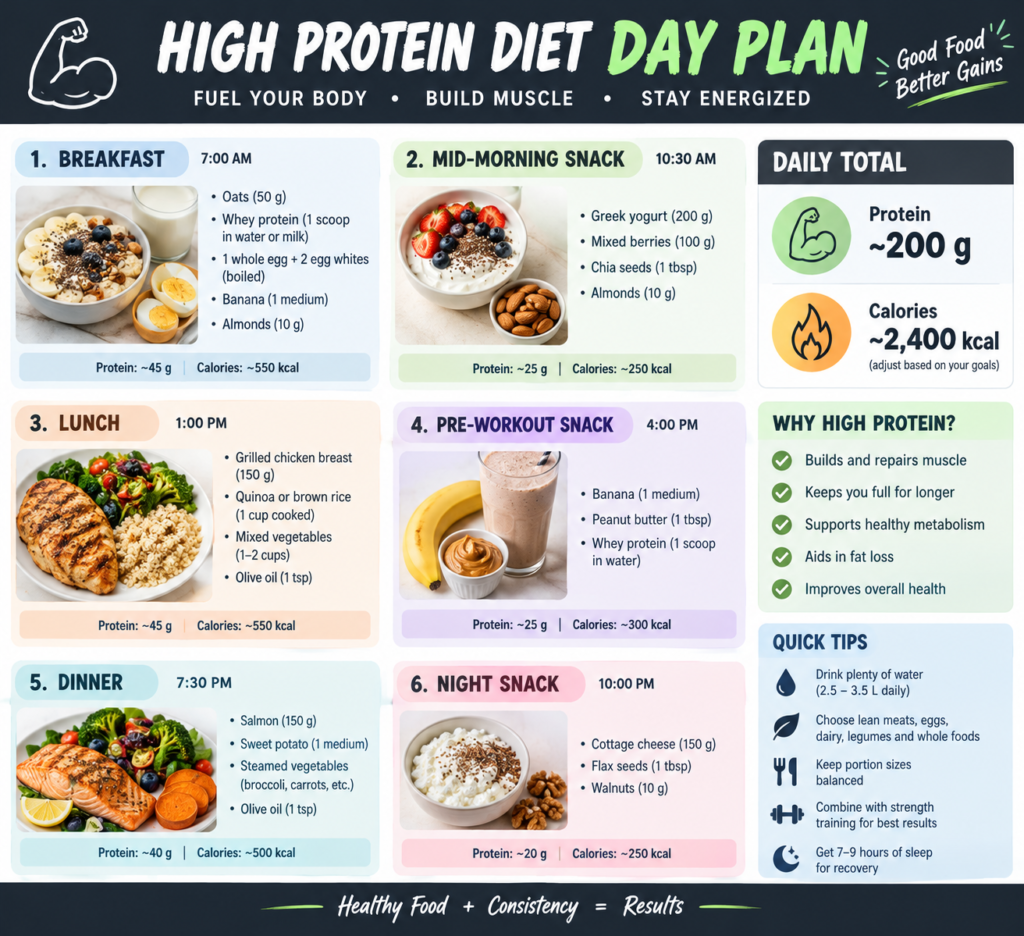
| Meal | Example |
|---|---|
| Early morning | Milk + banana + nuts |
| Breakfast | Paneer sandwich + yogurt |
| Snack | Roasted chickpeas + fruit |
| Lunch | Roti + dal + paneer + vegetables + curd |
| Pre-workout | Banana + milk |
| Post-workout | Paneer/tofu sandwich + fruit |
| Dinner | Roti + tofu/paneer + vegetables + curd |